7 Signs You Have a Slab Leak (And What to Do Before Calling a Plumber)
If your water bill jumped for no obvious reason, or you've felt a strange warm patch on your kitchen floor, you might be dealing with something more serious than a typical plumbing hiccup — a slab leak.
A slab leak is a leak in the water or sewer lines that run through or under your home's concrete foundation. Because the pipe is buried in solid concrete, these leaks rarely announce themselves the way a dripping faucet does. Instead, they show up as secondary clues: an odd sound, a damp patch, a crack that wasn't there last month.
Arizona homes are especially prone to them. Hard water leaves mineral deposits that corrode copper pipe from the inside out, our clay-heavy soil expands and contracts with the wet-dry swings of monsoon season, and a lot of Valley homes still have decades-old copper lines nearing the end of their service life. Add in triple-digit summer heat, and your plumbing is working against a lot.
The good news: slab leaks almost always give off warning signs before they turn into a major repair. Here are seven worth watching for, plus a simple check you can do yourself before you ever pick up the phone.
At a glance, here are the seven signs we'll cover:
- A water bill that's suddenly, unexplainably higher
- The sound of running water when every tap is off
- Warm or hot spots on your flooring
- Low water pressure throughout the house
- Musty or moldy smells with no visible water
- New cracks in flooring, walls, or your foundation
- Damp carpet or warped flooring with no clear source
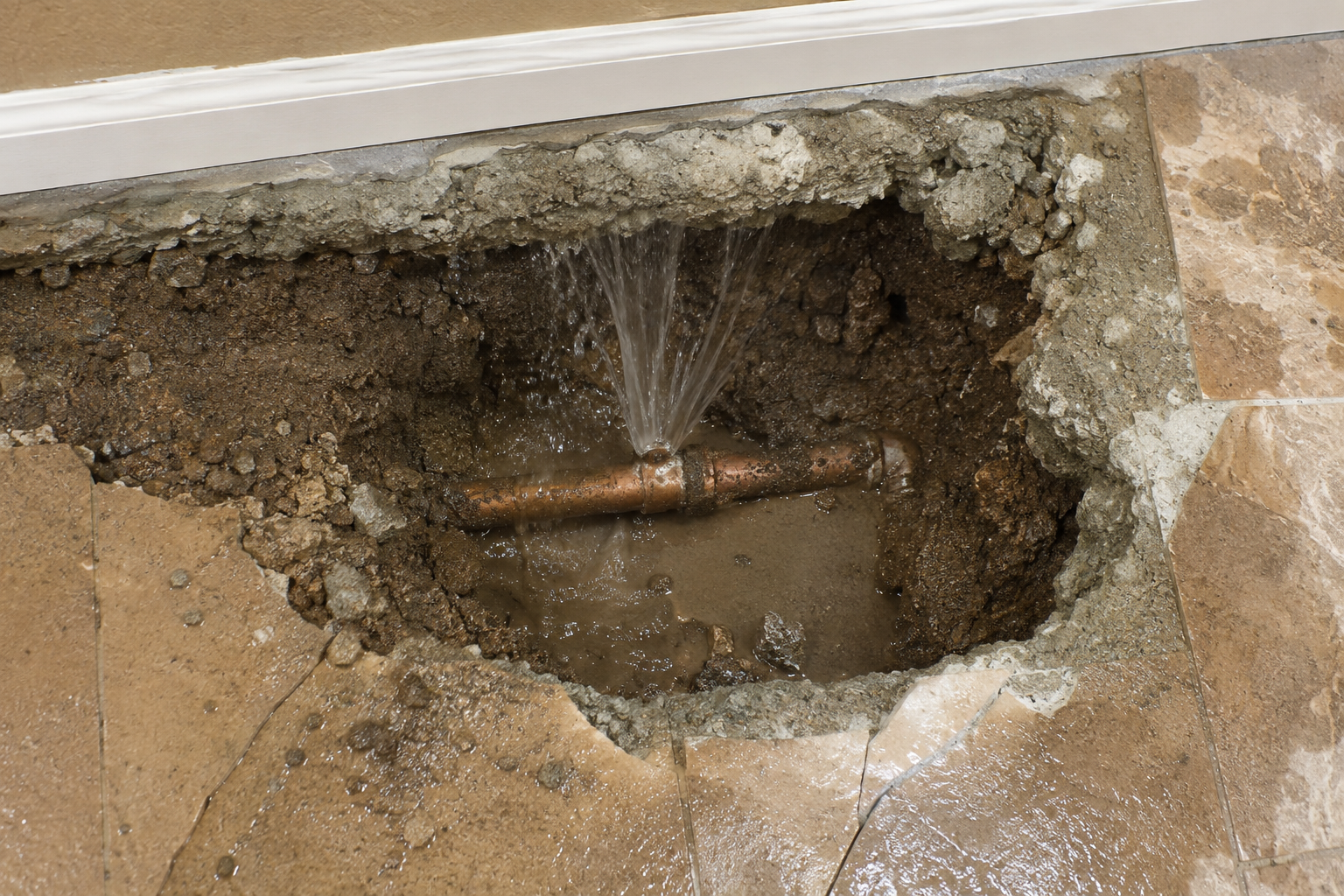
The 7 Signs of a Slab Leak
1. Your Water Bill Jumped for No Clear Reason
A slab leak runs 24 hours a day, whether you're home or not. That constant flow adds up fast, often showing up as a bill that's 20–50% higher than usual with no obvious explanation — no house guests, no new landscaping, no filled pool. If you can't account for the increase, it's worth investigating before you assume it's a billing error.
2. You Hear Water Running When Everything's Off
Walk through your home when it's quiet — late at night works well — with every faucet, appliance, and irrigation zone off. If you hear a faint hissing or rushing sound coming from inside a wall or up through the floor, that's water moving somewhere it shouldn't be.
3. Warm or Hot Spots on Your Floor
This is one of the more distinctive signs, and one Arizona homeowners notice more than most, since nearly every home here is built on a slab rather than over a basement. If a leak develops in a hot water line under the slab, the escaping hot water heats the surrounding concrete, which radiates up through your flooring. Walk barefoot across tile, laminate, or hardwood — a patch that feels noticeably warmer than the rest of the floor is a strong indicator of a hot-side slab leak.
4. Low Water Pressure Throughout the House
When water is escaping under your slab, less of it reaches your fixtures. A drop in pressure at a single faucet is usually just a clogged aerator. But a pressure drop across the whole house — especially if it's isolated to hot water only, or cold only — points toward water being lost somewhere in the line before it ever reaches your taps.
5. Musty or Moldy Smells With No Visible Water
In most of Arizona's dry climate, indoor mold and musty odors are unusual, which makes this sign especially telling here. If you notice a persistent musty smell near a baseboard, under a cabinet, or in one particular room — with no obvious water source — hidden moisture from a slab leak is a likely culprit.
6. New Cracks in Your Flooring, Walls, or Foundation
Water escaping under the slab can erode the soil that supports your foundation, causing it to shift. That shift often shows up as new cracks in tile or grout, hairline cracks along interior walls, or gaps around doors and windows that used to close easily and suddenly don't. Any of these, especially paired with another sign on this list, is worth a closer look.
7. Damp Carpet or Warped Flooring With No Obvious Cause
Water from a slab leak often finds its way upward through flooring seams or wicks into carpet padding. If you notice a damp patch, a section of warped laminate, or buckled hardwood that isn't anywhere near a sink, tub, or appliance, that's a strong sign the moisture is coming from underneath rather than above.
What to Do Before You Call a Plumber
If a couple of these signs sound familiar, you don't have to guess. Your water meter can tell you, in about fifteen minutes, whether water is flowing somewhere it shouldn't — no tools required beyond a flashlight and a little patience.
1. Find your water meter. It's usually in the ground near the curb or sidewalk at the front of your property, under a metal or plastic lid marked "water meter."
2. Turn off every source of water in and around your home. That means every faucet, toilet (don't flush during the test), washing machine, ice maker, irrigation controller, water softener, evaporative cooler, and pool equipment. Anything automatic needs to be switched off manually.
3. Check the leak indicator. Most meters have a small triangle, star, or dial that spins whenever water is flowing through the line. With everything off, it should be completely still. If it's moving, water is flowing somewhere.
4. Narrow it down. Shut off your home's main water shutoff valve — commonly found in the garage, near the water heater, or in a box near where the line enters the house — and check the meter again. If the indicator stops, the leak is inside your home's plumbing. If it keeps moving, the leak is in the line between the meter and your house.
A word of caution: this test only tells you that water is escaping, not where — and it can't distinguish a slab leak from a running toilet, a bad irrigation valve, or a leaking water softener. That's exactly where a professional with real detection equipment earns their keep, and why we'd steer you away from opening up concrete yourself. A slab leak that's misdiagnosed, or a repair attempted without pinpointing the actual leak first, usually costs more to fix the second time around.
When a Slab Leak Becomes an Emergency
Most slab leaks develop slowly, but a few signs mean it's time to skip the DIY test and call right away: standing water on your floor, a section of flooring that's visibly heaving or buckling, or running water that sounds loud and constant rather than faint. If you're dealing with any of these, reach out for emergency plumbing help rather than waiting.
Why Professional Leak Detection Matters
Finding a slab leak by guesswork means opening up concrete in the wrong spot — expensive, messy, and often unnecessary. Professional leak detection uses equipment built specifically to locate leaks under a slab without tearing up your entire floor, so the repair — whether that's a pipe reroute, an epoxy lining, or a targeted spot repair — can be as precise and minimally invasive as possible.
At Travis & Sons Plumbing & Rooter, we've been a family-owned, locally operated part of this community since 1989, and slab leaks are some of the most common calls we get across Fountain Hills and the greater Valley. Every technician we send to your home is licensed, insured, and background-checked, and we back our repairs with a 3-year warranty on labor and workmanship — well beyond the industry-standard 1-year warranty. If you catch one of these signs today, we offer same-day service, so you're not stuck waiting while a leak keeps doing damage underneath your home.
Think You Might Have a Slab Leak?
Don't wait on it. The longer a slab leak runs, the more it can erode the soil under your foundation, and the more expensive the eventual repair tends to be. If you've spotted one or more of the signs above, our team offers professional slab leak detection across the Valley, including Fountain Hills, Scottsdale, Gilbert, and Mesa. Curious what a repair typically costs? We break it down in our guide to the cost to fix a leak under a concrete slab.
Ready to get it checked out? Request service and we'll get a technician out to you — often the same day.
Matt Howard